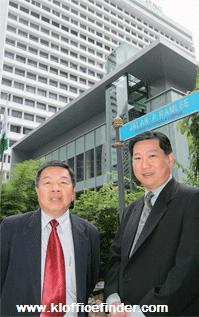
Monday, October 22, 2007
By THE EDGE
It is a tired 34-year-old office building in the heart of Kuala Lumpur's Golden Triangle. But its owners knew its location made it the right piece of property to be tapped to its full potential.
With just a few more floors of the 22-storey building to be refurbished, Menara Hap Seng Sdn Bhd — the owners of Menara Hap Seng — is excited about unveiling the RM60-million makeover of the former MUI Plaza on Jalan P Ramlee by year-end.
Menara Hap Seng Sdn Bhd is a wholly owned subsidiary of Main Board-listed Hap Seng Consolidated Bhd, which had bought the building together with an adjacent piece of land in 2004.
Property development is one of Hap Seng Consolidated's core businesses. The group is among Sabah's largest developers of townships and mixed landed developments. Its current projects in East Malaysia include Taman Kingfisher Sulaman in Kota Kinabalu, Bandar Sri Perdana in Lahad Datu, Astana Heights in Sandakan, Taman Miramas in Semporna and Bandar Sri Indah in Tawau. Menara Hap Seng marks its entry into the Klang Valley property market.
The once-grey building now sports sleek contemporary features and fittings and is envisioned to become a landmark Grade A office building in the Golden Triangle. Located opposite Shangri-la Hotel and behind Menara Weld, it is within walking distance of KLCC.
Many, even KL-lites, may not know this but the building was originally designed as a hotel, reveals Datuk Paul Ng, the chief executive of Hap Seng Land's property division.
This inspired the new owners to leverage on the building's unique design in its refurbishment plans, giving the office building the feel of a modern city hotel.
"For an office building, the design is rather peculiar. You will notice the long driveway and the systematic window grid, which are characteristics of a hotel. While researching the building's history, I found out that it was originally designed to house the former KL Hilton but for some reason that did not work out," says Ng.
The first three floors of the building will now be the retail podium of Menara Hap Seng, comprising a grand lobby, lounge areas, cafés and restaurants offering moderate to fine dining, and speciality stores. "This is where business meets leisure," says Ng.
To emphasise the "hotel" features of the building, the landlord will introduce services often found at a hotel lobby and entrance, such as valets and concierge service. There will even be a doorman to greet you as you walk in. About 75% of the building has already been leased out, with many of the tenants scheduled to come in once the refurbishment is completed. More offices will be open for lease then. The tenants include Maybank, CIMB, Mitsui-Sumitomo Insurance, The Korean Trade and Investment Agency and Borneo Oil & Gas Sdn Bhd. Those that were there before the new owners took over make up about 30% of present tenants.
"We are selective about our tenants because we want those who will utilise the facilities that we have here," Ng says, adding that the group wanted to offer Grade A offices in a prime location because "the demand is there, and also because we can keep them for investment".
One floor will be dedicated to serviced offices while the top five floors of the building will house the group's headquarters, which are currently in Petaling Jaya. Other facilities include high-speed elevators, spacious corridors and foyers, quality finishing, a modern building control system, 24-hour security and controlled access.
Chanced buy
According to Ng, Hap Seng acquired the building in 2004 by chance. "One of Hap Seng's businesses is selling Mercedes cars. (The group is the authorised dealer for Mercedes-Benz and Smart vehicles in Peninsular Malaysia).
"We were looking for a suitable site for our Mercedes showroom in KL and found this vacant lot. It so happened that the owner of the vacant lot owned the building (MUI Plaza) next door. So we thought, 'why not kill two birds with one stone and buy both the properties since it is under the same owner?' So we went knocking on the owners' door and persuaded them to sell the building as well. So we ended up buying two properties instead of one."
Hap Seng's impressive Mercedes-Benz Autohaus showroom is now located on a 31,000 sq ft site at the intersection of Jalan Sultan Ismail and Jalan P Ramlee, with Menara Hap Seng next door.
"At the time, we paid RM166 million for the building or around RM480 psf, a price one would have considered rather steep then. But we still went for it," says Ng.
Why? "As a property developer, one must have an eye for potential and visualise the opportunities. You must have the gut feel when it comes to investments and we had the gut feel for this property. And we believe it was the right decision and the money we paid for it has been worth it. It did not seem like a good buy at the time but on reflection, it is a good buy because today, the speculative pricing per sq ft, I would say, is almost RM800 psf," he adds.
Ng has 25 years of experience in the industry, with a background in architecture and property consultancy.
According to him, in 2004, the rental rate for MUI Plaza was around RM3.20 psf. Today, the rates for Menara Hap Seng range from RM4.70 to RM5 psf. "The rate for our next release of office space, which will be when the refurbishment is completed, will probably be around RM5.50 psf," he offers.
Each floor has a space of 13,000 sq ft and the minimum space for lease is 900 sq ft. The rental for the retail lots at the three-level retail podium ranges from RM5 to RM15 psf.
Mass housing
In Sabah, Hap Seng is known as a township and mass-housing developer, particularly in Tawau where it developed its first project. Among its townships is Bandar Sri Indah, which is 10 miles outside Tawau. It is the largest commercial-residential township develoment in Sabah, covering 1,368 acres. The total development consists of over 8,300 homes, 700 shoplots and 550 industrial lots. It also has amenities such as schools, a bus terminal, government departments, a market and a 300-acre ecopark.
Hap Seng has also built affordable housing in Sandakan, Kota Kinabalu and Lahad Datu. To date, it has erected over 8,000 mixed types of properties in excess of RM1 billion and still has more than 2,000 acres of undeveloped land.
However, the group realised that the property action was in West Malaysia, especially in the Klang Valley. It thus started scouting for opportunities to build or rebuild niche properties in strategic locations here. "We have developed our brand in Sabah but it is West Malaysia that has the potential for greater things for us.
"In KL, we want to focus on niche developments such as high-end condominiums and commercial buildings and towards this end, we are busy looking for land and good investment buildings," Ng says.
The developer is in the midst of completing the purchase of three vacant lots, one on Jalan Tun Razak and two on Jalan Kelang Lama. "When developed, we expect the total gross development value (GDV) for the three projects to be more than RM600 million," Ng discloses.
"We are a new developer here on an acquisition trail. We believe our strategy to acquire more land or old properties with potential for redevelopment must be based on prime locations and we don't mind paying top dollar for it. Location is very important for investment," he says, revealing the developer's deep pockets.
However, he adds, property owners are holding back from selling, in anticipation of price increases in the near future.
Puchong development
Besides Menara Hap Seng, the group hopes to launch its 88-acre D'Alpinia development in Puchong by year-end. The development comprises 76 acres of residential homes made up of superlinks, detached and semi-detached houses priced from RM300,000 to RM1 million plus, and 12 acres of commercial development. The total GDV is expected to be more than RM500 million.
"Unlike in Sabah, the KL market expects a lot more, so we have to provide a lot more. Things like auto gates, CCTV security systems, filtered water systems, all these will be standard features in our D'Alpinia homes because purchasers today consider these items as essentials in a home. Most of the time, they have to renovate and add these features on their own but with our homes, they probably won't have to," says Ng.
There was strong response to a pre-registration exercise for D'Alpinia's Phase 1A of 154 units. "There were 1,500 registrants when our whole project, when completed, will offer only 1,000 odd units. It looks like our reputation in Sabah has preceded us," Ng says.
Besides property investment and development, Hap Seng Consolidated is involved in credit financing, trading (fertilisers, automotive, building materials and petroleum), stone quarries and plantations. The group is one of the largest oil palm plantation companies in Sabah, with a total planted area of about 32,700ha. The group plans to list its plantation assets by year-end.
As at Jan 31, 2007, Hap Seng's paid-up capital stood at RM622.66 million while shareholders' funds stood at RM1.53 billion. For FY2007 ended Jan 31, it registered a profit after tax of RM121 million on a turnover of RM1.7 billion.
[E(3)0631] Contact: Max Yong Tel: +6012-2868877 Email: propertyworld.my@gmail.com
WELCOME TO MY BLOG
欢迎到我的博客
私のブログへようこそ
내 블로그에 오신 것을 환영합니다
مرحبا بكم في بلوق
私のブログへようこそ
내 블로그에 오신 것을 환영합니다
مرحبا بكم في بلوق
Showing posts with label Plaza Atrium. Show all posts
Friday, February 1, 2013
BB Plaza to make way for MRT station
Wednesday, June 27, 2012
Landmark: The iconic 38-year-old BB Plaza, located in the heart of Kuala Lumpur, will be demolished to make way for the MRT project.
KUALA LUMPUR: The 38-year-old Bukit Bintang Plaza (BB Plaza) will need to make way for the construction of a My Rapid Transit (MRT) station, contradicting earlier reports that only the front of the property and basement will be needed for development purposes.
UDA Holdings Bhd officials, who earlier met with BB Plaza’s tenants to clear up the confusion on the status of the property, said they had been asked to vacate the premises by MRT Corp by the end of the year in a meeting two weeks ago.
UDA, a wholly-owned entity under the ministry, owns BB Plaza as well as several other commercial properties in central Kuala Lumpur, Ipoh and Johor Baru.
UDA group managing director Ahmad Abu Bakar said at a media briefing that Tradewinds Corp Bhd, a property and hotel conglomerate majority-owned by media-shy tycoon Tan Sri Syed Mokhtar Al-Bukhary, had expressed its interest to acquire the property.
“We discussed it at the board and have related the offer back to the ministry, so we’ll wait for the decision,” he said, adding that there were parties who were interested to either jointly develop or acquire the property.
According to recent reports, Tradewinds Corp had approached UDA to redevelop BB Plaza under a 50:50 joint venture which the latter’s board had declined because the returns were not lucrative enough.
MRT Corp, the body tasked with overseeing the development of the MRT line, have previously said it has no plans to acquire BB Plaza, valued at an estimated RM500mil.
Ahmad said UDA had no plans to redevelop the property on its own due to the lack of funds. “There’s been talk of redevelopment but not in the near term as we don’t have the funds because we’re trying to clean up our balance sheet,” he clarified.
UDA’s senior vice-president of property management Syed Ahmad Nazri Syed Kamaruzaman said the company was just as surprised as the tenants that the property was going to be demolished.
“We had a meeting with the tenants because of the confusion over the status of the property especially after reports came out saying that BB Plaza will not be demolished. In all our meetings with the ministry, the understanding is that the property will be demolished,” he said.
Syed Ahmad Nazri said a letter from MRT Corp only requested UDA to vacate the front of the property while Ahmad pointed out that this has caused a lot of confusion.
“Initially MRT Corp told us that they just need the front portion and that the station will be underground.
“They said there was no need to demolish the whole building. Later on when we discussed with them, they said the whole building will have to be brought down, so this is the confusion of the last one month or so,” he said.
Meanwhile, Syed Ahmad Nazri said compensation for the tenants was discussed but it was the stance of the company that compensation should come from MRT Corp.
“In fact we’ve passed the claims of several of the tenants to MRT Corp and they have come back to us asking for more information. Even though there’s nothing formal, we’re working towards it,” he said.
By The Star
Growing supply of office space in Klang Valley
Saturday, January 23, 2010


PEPS president James Wong (inset) says there’s a large amount of new office space being developed around the fringe of Kuala Lumpur including Petaling Jaya, Damansara, Puchong and Mont’ Kiara.
KUALA Lumpur’s office market is in for a tough year in 2010 with the expected completion of another 4 million sq ft of new office space which may further dampen rental and occupancy rates.
Association of Valuers, Property Managers, Estate Agents and Property Consultants in the Private Sector (PEPS) president James Wong says there is also a large amount of new office space being developed around the fringe of Kuala Lumpur including Petaling Jaya, Damansara, Puchong, and Mont’ Kiara.
This is in addition to the 4 million sq ft completed last year of which a number of the buildings are still unoccupied although there are tenants that may be moving in later this year.
“With such a large amount of new office space, demand will not be able to keep up with the growing supply and this will result in more unoccupied space. Overall occupancy and rental rates are expected to face downward pressure this year,” Wong tells StarBizWeek.
He says while offices that are well-planned, managed and marketed will achieve high occupancy, there will be those that will be left vacant.
“Office occupancy and take-up in the city used to be around 2 million sq ft when the market was at its peak around late 2007 but it has since dropped to just over a million sq ft now,” Wong adds. The overall office occupancy rate is expected to decline further to about 80% this year from around 87% in the last quarter of 2009.
According to Wong, office demand is driven by the performance of the economy which in turn is a function of business investments.
“In Malaysia, a large part of this is foreign direct investments (FDIs). Hence, the key is to attract FDIs and to draw up incentives to change the economic model of the country to being knowledge-based and driven by high-technology.”
Hopefully, the Government’s aim of achieving a high income economic model will provide an impetus for higher take-up of office space, he says.
“The market’s revival will also depend on the implementation of the two stimulus packages and their spin offs to the economy,” Wong adds.
DTZ Nawawi Tie Leung executive director Brian Koh points out that the global economy will continue to be filled with uncertainties this year and inflow of FDIs are not expected to pick up in the near future.
“Within the next three to four years, there will be 14.4 million sq ft of purpose-built office space scheduled to be completed. Unless there is a surge in demand, the additional supply will cast a dampening impact on rental and occupancy rates in the next few years,” he says.
Koh agrees that a possible upside for the market will be the new economic model which will hopefully lift economic growth, especially in the services sector.
Re-Group Associates executive chairman Christopher Boyd says with office space vacancies hovering around 13%, it is still very much a tenant’s market.
“Tenants are spoilt for choice and rental rates have come off by around 20% to 25% so far, with grade A office space fetching between RM5 and RM6.50 per sq ft, while grade B from RM4 to RM5.50 per sq ft,” he says.
Boyd says despite the higher supply, Malaysia’s office market is not likely to crash.
“In fact, the low rental rates here are a boon for businesses. Being consistently inexpensive is a good thing for the business people as it makes it easier for them to plan ahead and make decisions,” he notes.
Zerin Properties chief executive officer Previndran Singhe concurs with Boyd, saying the rental correction in the office market is not alarming and “is just a normal market cycle.”
“The concern that the over supply will adversely impact the office market will only be short term and things should recover, especially with the ongoing liberalisation of the various business and financial services sectors.”
Demand for office space should pick up among oil and gas companies and financial services providers, he says, adding that building owners need to be more innovative to attract the right tenants. “In fact, landlords have become more realistic in how much rent they can ask for and rental rates will find their new equilibrium in time to come,” he says.
ECM Libra analyst Bernard Ching notes that there has been a pick up in the office property sub-segment with more local investors looking for quality assets.
In the last quarter of 2009, the investment market jumped by about 58% to RM1.39bil against the previous quarter. The purchasers comprised mainly real estate investment trusts, the Employees’ Provident Fund and government-linked companies.
Some of the notable deals concluded recently include a 50% equity interest in Menara Citibank by Hap Seng Consolidated Bhd, the acquisition of Tower D, Glomac Damansara by Lembaga Tabung Haji as well as the acquisition of a retail/office tower in Southgate by Permodalan Koperasi Felda.
Ching notes that the office market is expected to see more foreign participation in the coming months as the global economic recovery gathers momentum.
“This follows a series of well received economic initiatives to liberalise the economy to attract foreign participation, including the repeal of the Foreign Investment Committee which regulates mergers and acquisitions in the country,” Ching says.
By The Star (by Angie Ng)
KUALA Lumpur’s office market is in for a tough year in 2010 with the expected completion of another 4 million sq ft of new office space which may further dampen rental and occupancy rates.
Association of Valuers, Property Managers, Estate Agents and Property Consultants in the Private Sector (PEPS) president James Wong says there is also a large amount of new office space being developed around the fringe of Kuala Lumpur including Petaling Jaya, Damansara, Puchong, and Mont’ Kiara.
This is in addition to the 4 million sq ft completed last year of which a number of the buildings are still unoccupied although there are tenants that may be moving in later this year.
“With such a large amount of new office space, demand will not be able to keep up with the growing supply and this will result in more unoccupied space. Overall occupancy and rental rates are expected to face downward pressure this year,” Wong tells StarBizWeek.
He says while offices that are well-planned, managed and marketed will achieve high occupancy, there will be those that will be left vacant.
“Office occupancy and take-up in the city used to be around 2 million sq ft when the market was at its peak around late 2007 but it has since dropped to just over a million sq ft now,” Wong adds. The overall office occupancy rate is expected to decline further to about 80% this year from around 87% in the last quarter of 2009.
According to Wong, office demand is driven by the performance of the economy which in turn is a function of business investments.
“In Malaysia, a large part of this is foreign direct investments (FDIs). Hence, the key is to attract FDIs and to draw up incentives to change the economic model of the country to being knowledge-based and driven by high-technology.”
Hopefully, the Government’s aim of achieving a high income economic model will provide an impetus for higher take-up of office space, he says.
“The market’s revival will also depend on the implementation of the two stimulus packages and their spin offs to the economy,” Wong adds.
DTZ Nawawi Tie Leung executive director Brian Koh points out that the global economy will continue to be filled with uncertainties this year and inflow of FDIs are not expected to pick up in the near future.
“Within the next three to four years, there will be 14.4 million sq ft of purpose-built office space scheduled to be completed. Unless there is a surge in demand, the additional supply will cast a dampening impact on rental and occupancy rates in the next few years,” he says.
Koh agrees that a possible upside for the market will be the new economic model which will hopefully lift economic growth, especially in the services sector.
Re-Group Associates executive chairman Christopher Boyd says with office space vacancies hovering around 13%, it is still very much a tenant’s market.
“Tenants are spoilt for choice and rental rates have come off by around 20% to 25% so far, with grade A office space fetching between RM5 and RM6.50 per sq ft, while grade B from RM4 to RM5.50 per sq ft,” he says.
Boyd says despite the higher supply, Malaysia’s office market is not likely to crash.
“In fact, the low rental rates here are a boon for businesses. Being consistently inexpensive is a good thing for the business people as it makes it easier for them to plan ahead and make decisions,” he notes.
Zerin Properties chief executive officer Previndran Singhe concurs with Boyd, saying the rental correction in the office market is not alarming and “is just a normal market cycle.”
“The concern that the over supply will adversely impact the office market will only be short term and things should recover, especially with the ongoing liberalisation of the various business and financial services sectors.”
Demand for office space should pick up among oil and gas companies and financial services providers, he says, adding that building owners need to be more innovative to attract the right tenants. “In fact, landlords have become more realistic in how much rent they can ask for and rental rates will find their new equilibrium in time to come,” he says.
ECM Libra analyst Bernard Ching notes that there has been a pick up in the office property sub-segment with more local investors looking for quality assets.
In the last quarter of 2009, the investment market jumped by about 58% to RM1.39bil against the previous quarter. The purchasers comprised mainly real estate investment trusts, the Employees’ Provident Fund and government-linked companies.
Some of the notable deals concluded recently include a 50% equity interest in Menara Citibank by Hap Seng Consolidated Bhd, the acquisition of Tower D, Glomac Damansara by Lembaga Tabung Haji as well as the acquisition of a retail/office tower in Southgate by Permodalan Koperasi Felda.
Ching notes that the office market is expected to see more foreign participation in the coming months as the global economic recovery gathers momentum.
“This follows a series of well received economic initiatives to liberalise the economy to attract foreign participation, including the repeal of the Foreign Investment Committee which regulates mergers and acquisitions in the country,” Ching says.
By The Star (by Angie Ng)
Menara Hap Seng - a touch of modern simplicity

The Japanese garden located on the roof of Menara Hap Seng.
Set within the highly desirable and internationally acclaimed Golden Triangle of Kuala Lumpur, Menara Hap Seng is flanked by the majestic KLCC Twin Towers, the eminent KL Tower and the bustling presence of Bukit Bintang. This strategically located building (formerly known as MUI Plaza) was acquired in 2004 and is currently the Hap Seng Group’s corporate headquarters.
The building, which is on Jalan P. Ramlee, is a known landmark in the past and remains iconic till today. Having undergone a major facelift, Menara Hap Seng’s stunning facade and modern interior houses 21 levels of corporate suites.
In addition, there is also The Podium, which has a forecourt with water features, beautiful landscaping and three levels of alfresco dining, restaurants, retail outlets, banks and much more.
The building also boasts a seminar hall, meeting rooms and an auditorium. The Auditorium and Convention Centre in Menara Hap Seng is an addition to the Podium at Menara Hap Seng and seeks to provide a cost effective and flexible alternative to managing seminars and functions. There are two seminar rooms and one auditorium. The Auditorium has a capacity of 350 people while the seminar rooms have flexible arrangements of up to a maximum of 110 and 60 pax respectively.
This year Menara Hap Seng has been awarded the Malaysia Property Award 2009 in the “Office Development Category”.

Hap Seng Land chief executive (property division) Datuk Paul Ng Kee Seng.
“We are really happy and delighted with the win this year. This building has remained an icon on Jalan P. Ramlee and it will always be remembered fondly by the people in the Klang Valley and beyond,” said Hap Seng Land Sdn Bhd’s Chief Executive (Property Division) Datuk Paul Ng Kee Seng.
He further elaborated on the project. “This award has also set a new milestone for the Hap Seng brand. We are a wellestablished brand in the property industry. However, this recognition has brought the brand to greater heights given that we have proven our abilities in refurbishing an old building and giving it a new look and feel.”
Looking at Menara Hap Seng one would recognise the open and bright atmosphere of the building. Surrounded by various shops and dining outlets, its’ simplicity is distinctly unique.
“Menara Hap Seng stands out among the rest because it is able to bring a new vibrant and refreshing ambience into an office space. Its open concept and lifestyle attributes are reflective of our philosophy that office space need not be boring.”
Ng also added, “Menara Hap Seng is a reflection that Malaysians are capable of being innovative and creative when it comes to refurbishing or developing office spaces.”
Going green
In the past few years, the environment has been given much attention, including property development. Menara Hap Seng echoes the green theme by using nature as part of its design in making the office space a better environment to work in. The building has a skylight, which delivers large amounts of sunlight into the Podium. In the morning, the place is lit up with natural sunlight, which effectively saves electricity. The paint used is also environmental friendly.
Ng also said, “The building was old in its design. We took a simplistic or minimalistic concept that can be seen around in nature and emulate it to give Menara Hap Seng a cool and yet vibrant look.”
Ng continued by saying “The design for the office space needs to be highly functional yet appealing to our tenants. As such, it is a positive sign that all our available office space has been taken up, and on top of that, we receive constant request for our office space.”
Best Office Development
An office space must have an aura of comfort and satisfaction for the working person and this is aptly demonstrated at Menara Hap Seng. Ng said, “Menara Hap Seng has everything in one place, from eateries, clothing stores right up to a golf shop; everything is in place making it convenient for tenants,”
Menara Hap Seng has a wonderful concept of having the Podium with all the surrounding outlets in it. It was this concept that was one of the reasons for giving Menara Hap Seng a facelift.
When envisioning the office space, the beauty and practicality was also the main theme in making it unique. “We want to have beauty in simplicity!” said Ng. Many people who come into our building are not our tenants but those in search of food, entertainment, banking or even some retail therapy. The energy and ‘chi’ this building brings is absolutely amazing,” said Ng.
Menara Hap Seng is a unique building with its own characteristics.
The simple and beautiful make of this office space makes the building a benchmark among other office spaces around KL.
Ng continued, “My dream is that Menara Hap Seng starts off Jalan P. Ramlee into a walkway of fun and fiesta. It would be gratifying if the stretch from Menara Hap Seng all the way to Bukit Bintang be called the ‘P. Ramlee Walk’. This building is as iconic as Malaysian’s legendary artist P. Ramlee.”
With dreams and aspirations such as that, no wonder Menara Hap Seng has been made winner in the “Office Development Category.”
An iconic building contributing to the energy in KL, only more can be expected from this dynamic building and its’ plentiful offerings.
By The Star (by Prakash Daniel - Malaysia Property Award 2009 - Best Office Development)
Set within the highly desirable and internationally acclaimed Golden Triangle of Kuala Lumpur, Menara Hap Seng is flanked by the majestic KLCC Twin Towers, the eminent KL Tower and the bustling presence of Bukit Bintang. This strategically located building (formerly known as MUI Plaza) was acquired in 2004 and is currently the Hap Seng Group’s corporate headquarters.
The building, which is on Jalan P. Ramlee, is a known landmark in the past and remains iconic till today. Having undergone a major facelift, Menara Hap Seng’s stunning facade and modern interior houses 21 levels of corporate suites.
In addition, there is also The Podium, which has a forecourt with water features, beautiful landscaping and three levels of alfresco dining, restaurants, retail outlets, banks and much more.
The building also boasts a seminar hall, meeting rooms and an auditorium. The Auditorium and Convention Centre in Menara Hap Seng is an addition to the Podium at Menara Hap Seng and seeks to provide a cost effective and flexible alternative to managing seminars and functions. There are two seminar rooms and one auditorium. The Auditorium has a capacity of 350 people while the seminar rooms have flexible arrangements of up to a maximum of 110 and 60 pax respectively.
This year Menara Hap Seng has been awarded the Malaysia Property Award 2009 in the “Office Development Category”.

Hap Seng Land chief executive (property division) Datuk Paul Ng Kee Seng.
“We are really happy and delighted with the win this year. This building has remained an icon on Jalan P. Ramlee and it will always be remembered fondly by the people in the Klang Valley and beyond,” said Hap Seng Land Sdn Bhd’s Chief Executive (Property Division) Datuk Paul Ng Kee Seng.
He further elaborated on the project. “This award has also set a new milestone for the Hap Seng brand. We are a wellestablished brand in the property industry. However, this recognition has brought the brand to greater heights given that we have proven our abilities in refurbishing an old building and giving it a new look and feel.”
Looking at Menara Hap Seng one would recognise the open and bright atmosphere of the building. Surrounded by various shops and dining outlets, its’ simplicity is distinctly unique.
“Menara Hap Seng stands out among the rest because it is able to bring a new vibrant and refreshing ambience into an office space. Its open concept and lifestyle attributes are reflective of our philosophy that office space need not be boring.”
Ng also added, “Menara Hap Seng is a reflection that Malaysians are capable of being innovative and creative when it comes to refurbishing or developing office spaces.”
Going green
In the past few years, the environment has been given much attention, including property development. Menara Hap Seng echoes the green theme by using nature as part of its design in making the office space a better environment to work in. The building has a skylight, which delivers large amounts of sunlight into the Podium. In the morning, the place is lit up with natural sunlight, which effectively saves electricity. The paint used is also environmental friendly.
Ng also said, “The building was old in its design. We took a simplistic or minimalistic concept that can be seen around in nature and emulate it to give Menara Hap Seng a cool and yet vibrant look.”
Ng continued by saying “The design for the office space needs to be highly functional yet appealing to our tenants. As such, it is a positive sign that all our available office space has been taken up, and on top of that, we receive constant request for our office space.”
Best Office Development
An office space must have an aura of comfort and satisfaction for the working person and this is aptly demonstrated at Menara Hap Seng. Ng said, “Menara Hap Seng has everything in one place, from eateries, clothing stores right up to a golf shop; everything is in place making it convenient for tenants,”
Menara Hap Seng has a wonderful concept of having the Podium with all the surrounding outlets in it. It was this concept that was one of the reasons for giving Menara Hap Seng a facelift.
When envisioning the office space, the beauty and practicality was also the main theme in making it unique. “We want to have beauty in simplicity!” said Ng. Many people who come into our building are not our tenants but those in search of food, entertainment, banking or even some retail therapy. The energy and ‘chi’ this building brings is absolutely amazing,” said Ng.
Menara Hap Seng is a unique building with its own characteristics.
The simple and beautiful make of this office space makes the building a benchmark among other office spaces around KL.
Ng continued, “My dream is that Menara Hap Seng starts off Jalan P. Ramlee into a walkway of fun and fiesta. It would be gratifying if the stretch from Menara Hap Seng all the way to Bukit Bintang be called the ‘P. Ramlee Walk’. This building is as iconic as Malaysian’s legendary artist P. Ramlee.”
With dreams and aspirations such as that, no wonder Menara Hap Seng has been made winner in the “Office Development Category.”
An iconic building contributing to the energy in KL, only more can be expected from this dynamic building and its’ plentiful offerings.
By The Star (by Prakash Daniel - Malaysia Property Award 2009 - Best Office Development)
Hap Seng buys half of Menara Citibank, KLCC
Saturday, August 8, 2009


Hap Seng Consolidated Bhd has bought half of Inverfin Sdn Bhd, owner of Menara Citibank in Jalan Ampang, Kuala Lumpur, for about RM310 million. Its subsidiary, Hap Seng Realty Sdn Bhd (HSR) bought all interests in Inverfin owned by CapitalLand Ltd and Amsteel Corp Bhd.
The remaining half of Inverfin is owned by Menara Citi Holding Co Sdn Bhd. A Citibank Malaysia spokesperson said it is not in talks to sell its 50 per cent stake in Inverfin. Late last year it wanted to sell its interest in Inverfin to IOI Corp Bhd but the deal fell through.
The Amsteel stake comprising 2,000,001 shares is presently charged to RHB Investment Bank Bhd. This confirmed a Business Times report on June 30 2009 that Hap Seng was interested to buy half of Menara Citibank.
Inverfin is a special purpose entity and investment company formed for the sole purpose of owning and operating Menara Citibank.
At the end of August 2007, Inverfin issued medium term notes of RM160 million to selected investors where it charged Menara Citibank as security in respect of the notes.
Menara Citibank is built on a parcel of freehold land, measuring 12,694 sq m and has a net lettable area of 68,156 sq m.
Inverfin is the proprietor of Menara Citibank, and shares the use of five levels of basement car parks with the proprietor of an adjacent property known as "Hotel Nikko".
The purchase price of Inverfin is based on 50 per cent of the net asset value of the company as at June 30, after taking into account the agreed property value of Menara Citibank which is fixed at RM607,45 million. It is understood that Hap Seng is paying RM850 per sq ft of lettable area.
The transacted prices of prime office buildings within the Golden Triangle and the Central Business District were in the range of RM800 to RM1,200 per sq ft of lettable area.
The gross rental revenue based on the latest audited accounts of Inverfin for the financial year ended December 31 2008 was approximately RM48.76 million, giving a gross yield of 8.03 per cent.
Inverfin's operating profit was RM38.13 million, giving a net yield of 6.28 per cent. The rental revenue and operating profit are expected to improve with the rent rollover for year 2009 onwards, Hap Seng said in a statement to Bursa yesterday.
Hap Seng said the purchase is consistent with the group's corporate business direction of expanding its property division both for development and investment holding.
Menara Citibank is located in an established commercial precinct and is expected to rise further in popularity.
Hap Seng proposes to borrow from banks up to RM200 million to pay for the purchase, while the balance will be paid by internally generated funds.
With the acquisition, Hap Seng's gearing ratio is expected to increase from 1.06 to 1.14 based on its audited accounts as at December 31 2008.
By Business Times
The remaining half of Inverfin is owned by Menara Citi Holding Co Sdn Bhd. A Citibank Malaysia spokesperson said it is not in talks to sell its 50 per cent stake in Inverfin. Late last year it wanted to sell its interest in Inverfin to IOI Corp Bhd but the deal fell through.
The Amsteel stake comprising 2,000,001 shares is presently charged to RHB Investment Bank Bhd. This confirmed a Business Times report on June 30 2009 that Hap Seng was interested to buy half of Menara Citibank.
Inverfin is a special purpose entity and investment company formed for the sole purpose of owning and operating Menara Citibank.
At the end of August 2007, Inverfin issued medium term notes of RM160 million to selected investors where it charged Menara Citibank as security in respect of the notes.
Menara Citibank is built on a parcel of freehold land, measuring 12,694 sq m and has a net lettable area of 68,156 sq m.
Inverfin is the proprietor of Menara Citibank, and shares the use of five levels of basement car parks with the proprietor of an adjacent property known as "Hotel Nikko".
The purchase price of Inverfin is based on 50 per cent of the net asset value of the company as at June 30, after taking into account the agreed property value of Menara Citibank which is fixed at RM607,45 million. It is understood that Hap Seng is paying RM850 per sq ft of lettable area.
The transacted prices of prime office buildings within the Golden Triangle and the Central Business District were in the range of RM800 to RM1,200 per sq ft of lettable area.
The gross rental revenue based on the latest audited accounts of Inverfin for the financial year ended December 31 2008 was approximately RM48.76 million, giving a gross yield of 8.03 per cent.
Inverfin's operating profit was RM38.13 million, giving a net yield of 6.28 per cent. The rental revenue and operating profit are expected to improve with the rent rollover for year 2009 onwards, Hap Seng said in a statement to Bursa yesterday.
Hap Seng said the purchase is consistent with the group's corporate business direction of expanding its property division both for development and investment holding.
Menara Citibank is located in an established commercial precinct and is expected to rise further in popularity.
Hap Seng proposes to borrow from banks up to RM200 million to pay for the purchase, while the balance will be paid by internally generated funds.
With the acquisition, Hap Seng's gearing ratio is expected to increase from 1.06 to 1.14 based on its audited accounts as at December 31 2008.
By Business Times
Subscribe to:
Posts (Atom)
Seri Maya Condominium, Jalan Jelatek
Seri Maya is a condominium comprising of lowrise and highrise apartments with a total units of 1400 apartment approximately. There are 2 lap pools, 3 gymansiums, 3 children playgrounds and 24hr security. It is located 4km away from KLCC, close to amenities, particularly the Putra LRT Station (the LRT to KLCC & PJ) is situated right opposite Seri Maya. 90% of the occupants are expatriates.
In view of the current economy slowdown, Seri Maya has become an alternative dwellings for KLCC expatriates. There are a lot of tenants (expatriates) migrated from KLCC condo to Seri Maya - reasons being, Seri Maya is easily accessible to KLCC via LRT, expats community, safe living environment, more greens and much more affordable!
